Sometime before 1641,1 there was a French mathematician who realized he had to start over — not his mathematical research, but all of it, his whole mind. “It is some years now since I realized how many false opinions I had accepted as true from childhood onwards,” he said, “and that, whatever I had since built on such shaky foundations, could only be highly doubtful.” He realized that his whole human experience had to be started over from the beginning, from zero. “I saw that at some stage in my life the whole structure would have to be utterly demolished, and that I should have to begin again from the bottom up.”2 Over a period of seven days, he – his name is René Descartes, by the way – started all over, and recorded each day, the result of which were his Meditations on First Philosophy, “first philosophy” because this is where it has to start again, this is his “first philosophy,” all else is second, third, fourth, and so on.
What arose from René Descartes’ Meditations on First Philosophy was the modern philosophical school of Skepticism. When the New Atheists (Richard Dawkins, Christopher Hitchens, Sam Harris, et al.) arose in the 2000s, many of their online followers proclaimed themselves to be “skeptics” in the line of Descartes. Ironically, those followers committed the very fallacy that Descartes tried to rid himself off: to live decades with a set of unscrutinized mental systems. Descartes did not doubt everything all the time (after all, his scholarship rested on the daily surety that 2 + 2 = 4 or that a² + b² = c²), but he doubted everything once over a period of seven days.
And this is indeed healthy, not just for the New Atheists and their ridiculous religion, but for all of us. Over days and then sudden decades we develop beliefs and opinions, and entire political, philosophical, scientific, and religious systems around those, while never questioning how much of it originated from hearsay, how much of it is hot steam, or how much of it needs to be torn down together with everything on top.
And yes, despite Descartes being an Enlightenment philosopher, this sort of Skepticism — true Skepticism, not New Atheism skepticism — is an integral part of the religious experience. St. Matthew was a tax collector before becoming one of Christ’s disciples.3 Saul was a Roman who persecuted Christians, until on the road to Damascus, the Risen Christ Himself motivated him to start over, turning Saul into St. Paul.4 St. Sebastian was a Roman soldier too before he became a martyr for Christ under the Diocletianic persecutions in the 3rd century.5 St. Francis of Assisi was born the son of a wealthy father in the year 1182,6 before one day, St. Bonaventure tells us, “he cast aside his purse and his money,” and “contended him with one scanty tunic” instead, declaring that “This is what I desire, yea, this is what I long for with my whole heart.”7 St. Edith Stein was born a Jew,8 but became an atheist before she read St. Teresa of Ávila, declared that “This is the truth,”9 and became a Carmelite nun in the convent in Cologne in 1933.10 I, born a Buddhist, became a Carmelite for the same reason: because I found St. Teresa’s way and wisdom are truthful. The religious experience demands that we discard our old beliefs once in a while to let a new light dawn from the darkness.
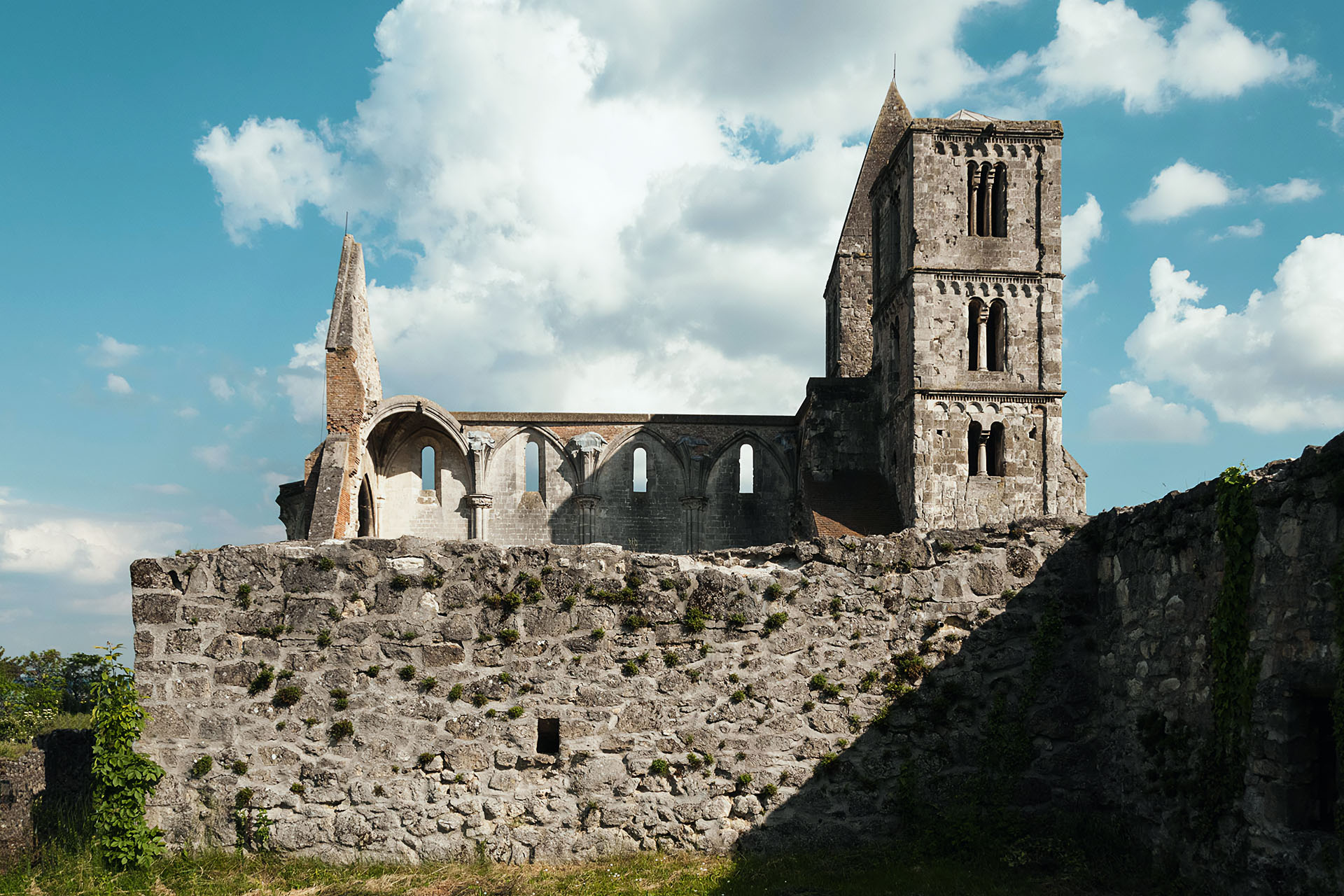
We should not be too careful to commit, to build our “crystal castle,” as St. Teresa of Ávila called it,11 brick by brick, commitment by commitment; still, sometimes it is necessary to tear down the whole structure before the structure tears itself down. Roman paganism is not a sustainable structure, that is why St. Paul and St. Sebastian discarded it, and why it died centuries later. Pleasure is not a sustainable structure, that is why St. Francis discarded it. Atheism is not a sustainable structure, that is why St. Edith Stein discarded it. New Atheism is not a sustainable structure, that is why young people today are discarding it.12 Our crystal castle must be built on a foundation made of crystal.
In this way, René Descartes has actually highlighted a crucial aspect of the religious experience: conversion, the act of converting a crumbling castle by tearing it down and building a crystal castle in its place. And being the brilliant mathematician that he is (he invented the Cartesian coordinate system after all), he realized that constant conversion is destruction; so you need to convert once, make it “a massive task,” as he called it, “the task of destroying all … former opinions,”13 so that a new light might dawn from the darkness.
But when do you decide to do it? Well, watch your castle, and watch out for the cracks. Do doubts arise? Or feelings that harm your trust in the foundation of those beliefs and opinions you hold? Can you fortify them with reason — what we call Rationalism — or with experience — what we call Empiricism? For if neither suffices, then this might be a reason to rebuild your castle, or at least to repair it.
And sometimes, repairing a few cracks is indeed better than rebuilding the whole structure. St. John Henry Newman did not switch sides completely to convert from Roman paganism to Christianity like St. Paul or St. Sebastian did, nor did he put away with all his possessions like St. Francis; instead, he just repaired the few cracks in a castle that was already built on a crystal foundation — that foundation being Christ —, and decided in 1845 that the castle now looked very Catholic instead of Anglican.14 Robert Hugh Benson followed him in 1903;15 G. K. Chesterton in 1922.16 Your marriage does not need to come down just because a few cracks have shown up. Repair your marriage, or completely renovate it before it comes crashing down. Rarely is a radical restart a la René Descartes necessary; most things can be repaired.
St. John of the Cross warned about the same, about confusing “the purgation of sense” with “dryness” as “the result of sins or of imperfections recently committed;” or in other words, about confusing a true dark night of the soul with “aridities” that proceed merely from “sins or imperfections, from weakness or lukewarmness, from some physical derangement or bodily disposition.”17 A dark night of the soul is not the same as dry prayer. Because one is purification, the other is profanity, even though they may seem the same. “I am brought to nothing, and I knew not,” as the Psalmist says.18 In the same manner, you must discern and distinguish whether your crystal castle is just showing cracks, or whether the foundation it is built upon is actually flawed.
Therefore, do not decide upon this lightly. “This seemed to be a massive task, and so I postponed it,” Descartes said, “I have delayed so long…”19 And why delay this daunting task? Because the easiest way to prove the necessity of rebuilding instead of repairing is to wait. As a general rule, if you feel like the cracks are constantly increasing, and your whole castle could come crashing down at any moment — that is, if you cannot defend any of your opinions neither with reason nor with experience, if your religion is practiced more out of familiarity than faith, if your partnership is all pain with no purpose —, then it might be the time to restart and rebuild. Discern wisely whether to restart or to just repair. Do the cracks after many repairs remain? Then stop repairing, and start rebuilding.
Fortunately, for us Catholics, we are not reliant upon ourselves in this discernment. We have priests and priors to ask for advice, a parish community to consult and care for us, mystics such as St. Teresa of Ávila or St. John of the Cross from whose wisdom and ways we can be fed as we undertake the “massive task.” As Ecclesiastes advised: “It is better therefore that two should be together, than one: for they have the advantage of their society: If one fall he shall be supported by the other: woe to him that is alone, for when he falleth, he hath none to lift him up.”20 Or St. Paul: “If one member suffer any thing, all the members suffer with it.”21 Real castles were not built by lone builders, neither must our crystal castle be. That is why we have the Church.
Unfortunately for Descartes, he resisted the clergy that could have helped him discern the “massive task” he set out to perform. Still, René Descartes’ Meditations on First Philosophy are an integral part of the curriculum in all the Philosophy courses around the world. He was born 430 years ago, on March 31st, 1596. Today is his birthday.
*
* *
Signed Mannheim, December 2nd, 2025. Published March 31st, 2026, the 430th birthday of René Descartes.
- See Descartes, René, Meditations on First Philosophy, With Selections from the Objections and Replies, transl. Michael Moriarty, (Oxford: Oxford University Press, 2008), xvi. ↩︎
- Ibid. 13. ↩︎
- DRB, Mt. 9:9. ↩︎
- DRB, Acts 9:1-18. ↩︎
- See Löffler, Klemens, “Sebastian,” The Catholic Encyclopedia, Vol. 13 (New York: The Encyclopedia Press, Inc., 1913), 668. ↩︎
- Chérancé, Léopold de, Saint François d’Assise (Paris: E. Plon, Nourrit et cie., 1892), 2. ↩︎
- Bonaventure, The Life of Saint Francis (London: J. M. Dent & Co., 1904), 23. ↩︎
- Reneta Posselt, Teresia, Edith Stein, The Life of a Philosopher and Carmelite (Washington, D.C.: ICS Publications, 2005), 3. ↩︎
- See Sokol, Jennifer, ‘This Is the Truth’ — Edith Stein Saw Human Dignity in the Light of the Cross (National Catholic Register, Oct 21, 2021), www.ncregister.com/blog/edith-stein-this-is-the-truth (accessed Nov 30, 2025). ↩︎
- See Reneta Posselt, Edith Stein, The Life of a Philosopher and Carmelite, 114-130. ↩︎
- Teresa of Ávila, The Interior Castle, trans. Kieran Kavanaugh, Otilio Rodriguez, The Collected Works of Saint Teresa of Avila, Vol. 2. (Washington, D.C.: ICS Publications, 2017), 283. ↩︎
- Cf. McDade, Stefani, “New Atheism Is Dead. What’s the New New Atheism?” Christianity Today (Sep 2023), www.christianitytoday.com/2023/08/new-atheism-is-dead/ (accessed Dec 2, 2025) ↩︎
- Descartes, Meditations on First Philosophy, 13. ↩︎
- See White, Newport J. D., John Henry Newman (London: Society for Promoting Christian Knowledge, 1925), 104-118. ↩︎
- See Martindale, C. C., The Life of Monsignor Robert Hugh Benson, Vol. 1 (London: Longmans, Green & Co., 1917), 119-267. ↩︎
- See Barker, Dudley, G. K. Chesterton, A Biography (New York: Stein and Day, 1973), 238-251. ↩︎
- John of the Cross, The Dark Night of the Soul, trans. Benedict Zimmermann (London: Thomas Baker, 1908), 34. ↩︎
- DRB, Ps. 72:22. Cf. John of the Cross, The Dark Night of the Soul, 46. ↩︎
- Descartes, Meditations on First Philosophy, 13. ↩︎
- DRB, Eccl. 4:8-10. ↩︎
- DRB, 1 Cor. 12:26. ↩︎
