
I. Poetry turned out profitable
“Three poets, in three distant ages born,
Greece, Italy, and England did adorn.
The first in loftiness of thought surpassed,
The next in majesty, in both the last:
The force of Nature could no farther go;
To make a third, she joined the former two.”
In this pretty little poem, John Dryden reveres the trinity of great poets, these are Homer, Dante, and the greatest of the three, Shakespeare. Or was it Homer, Virgil, and Milton? Well, Peter Weston in his Penguin Books explanation of Milton’s Paradise Lost believes the latter1 — and rightfully so, we might say. Whether Dante or Virgil is to be considered Italy’s greatest poet — and Dante seemed to believe that the honors belonged not to himself but to Virgil, and being Italy’s greatest poet, Dante is, of course, automatically right on this issue — is the headache of hundreds in the halls of academia, but at least the throne of England’s greatest poet has been usurped, controversially perhaps, from Shakespeare by Milton. This war has been waged by Milton at the cost of his father’s pride, his political career, and even his sight, but it was a war waged victoriously. As Prof. Nigel Smith from Princeton University attests, “Most of the [United States] founding fathers read Milton and revered him,”2 because he is a poet for the entire political spectrum, “whether conservative, liberal, or radical.”3 And as I, a student, attest, Milton is at once fiercely traditional and fiercely modern, and his magic, more than Shakespeare, can be felt in the classrooms of English literature even until today. Safe to say, Milton’s investment into poetry turned out to be profitable, posthumously as he already assumed and upon his father’s patience,4 but still: John Milton is now England’s greatest poet.
Yet there is something peculiar in this list of five, because of these five — Homer, Virgil, Dante, Shakespeare, and Milton — it is only Dante who did not write a classical epic poem. Homer did, the Iliad as well as the Odyssey; Virgil did the Aeneid; Shakespeare a minor epic titled Venus and Adonis; Milton his magnum opus Paradise Lost, which he so thoroughly conceptualized as an English epic. But Dante’s magnum opus, the Divina Commedia or Divine Comedy, is not an epic poem, at least not in the classical sense. An epic has a superhuman or divinely aided hero who goes on an adventure — Achilles in the Iliad, Odysseus in the Odyssey, Aeneas in the Aeneid, Satan in Paradise Lost, and we may add, I dare say, Luke Skywalker in Star Wars —, but who is the hero of Dante’s Divine Comedy? Dante himself, a feeble Florentine? An epic poem speaks of the war between good and evil — we see it in Odysseus fighting monsters around the Mediterranean, in Satan’s struggle against “the Tyranny of Heav’n,”5 or even in the forces of Star Wars which are literally called “the light” and “the dark side of the Force” —, but where are these two sides represented in the Divine Comedy? Does Dante ever fight a monster, or anyone or anything even? It is only when comparing the original poem to the 2010 computer game “Dante’s Inferno” by Electronic Arts that we clearly see how passively mortal the original Dante is. Furthermore, an epic poem is written in blank verse — neither the Iliad, the Odyssey, the Aeneid, nor Paradise Lost, being made in their image, does rhyme —, and many Italian and Spanish poets have adopted this practice, but not Dante, as the Divine Comedy does rhyme. And it does not rhyme in heroic couplets, otherwise we might recognize in it traces of the medieval troubadours. Instead, it rhymes in Terza rima, a form and term so orthodox to Dante’s poetry that I cannot be bothered on a Tuesday afternoon to call it anything other than “Dantean triplets,” the author becoming an adjective to his own invention, like the adjectives “Miltonic” or “Spenserian.” Of course, popular culture, myself included, often refers to the Divine Comedy as “Dante’s epic,” and our scholars consider it a sort of “Christian epic,” but the adjective “Christian” here is really only used to excuse its peculiarity. Long story short: Dante sticks out. He is a great poet, yes, but not an epic poet, at least not in the classical sense.
I think there is a lesson to be learned here when we put these two poets, Dante and Milton, side-by-side, Dante an Italian Catholic and Milton an English Puritan. And I deliberately point out that Milton was a Puritan, not a mere Anglican, because the Puritans, as the slur suggests, were communally concerned with doctrinal and liturgical purity. Since King Henry VIII put the English people through schism at around 1534 because he sought divorce from his doll-birthing dame Catherine of Aragon, the Church of England fluctuated between tradition and reform. The High Church wing wanted something more akin to traditional Roman Catholicism whereas the Low Church wing, most extreme amongst these the Puritans, wanted to “purify” the Church of England of these practices they deemed wretched and wrong for worship. John Milton, being born into a converted Protestant family in 1608, became a pamphleteer and politician for the latter’s cause, his career culminating in his appointment as the Secretary of Foreign Tongues6 in 1649, a position he obtained because he spoke more languages than the other four poets on our list combined, including the vulgar language in which the Divine Comedy was written — Italian —, and the, I dare say, vulgar language spoken by the Son of Man Himself — Aramaic.7 He maintained this office from 1649 until 1660, meaning he served under Oliver Cromwell, who ascended to Lord Protector in 1653 until his death in 1658. As we can see, John Milton was not merely a Puritan, he was an activist, a publicist, and, finally, a politician for his cause — think of Charlie Kirk, had he not been assassinated, but lived on to become a potent statesman and a blind poet thereafter.
II. Poetry once pagan, ever pagan
All this being said, I will now proceed to criticize Milton’s poetry. Luckily, Milton being a Puritan means that he did not believe in Purgatory, so I might receive no punishment in it for doing what I plan to do. Still, the halls of academia will inevitably wish my punishment to be eternal, and I cannot even take offence in their defence because, as aforementioned, Milton is England’s greatest poet. This nonetheless leads us to inquire: Why did Milton write an epic? In 1673, a year before his death, Milton published another one of his polemical pamphlets, this one titled “Of True Religion” and subtitled “And what best means may be us’d against the growth of Popery.” It is an anti-Catholic pamphlet in which Milton criticizes the Catholic Church primarily for its alleged misuse of Scripture. He argues that “The Scripture is our only Principle in Religion,”8 a position not untypical of Reformed groups even today. The commonly used term “Bible,” by the way, comes from the Greek “biblia” and means plural “books,” not the singular book. The Bible is a collection of books.
This begs the question: Why did Milton not avail himself in the biblical genres, but instead chose to imitate Homer and Virgil, a Greek and a Roman pagan, in writing Paradise Lost as an epic poem? Why did Milton write an epic? It is an excusable error for pre-Christian pagans to conceptualize the universe in a polytheistic manner — think of the first few chapters of Ovid’s Metamorphoses —, but it is, to use Milton’s own words, “Heresie … a Religion taken up and believ’d from the traditions of men”9 for a Christian to depict Sin and Death like pagan deities10 because the traditional epic form demands it so. It is entertaining, yes, but theologically, it is entirely wrong, as wrong as it is for Marvel Studios to teach our children about Thor. If not heresy, then is this not at least hypocrisy on Milton’s behalf? And if these figurative depictions are mere allegory, as Milton himself might excuse, then ought not the the Golden Calf11 be mere allegory too? But I find soothing, at least, in reading how Milton calls upon the Holy Spirit to be his “Heav’nly Muse,” and replaces Mount Olympus with Sinai and Horeb,12 thus baptizing the classical epic form with droplets of holy water; though all the deeper is my disappointment, because I would have expected a polemical Puritan such as him to not merely dribble the epic with holy water, but drown it in gushes of Jordan. Let me, a “Popist,” accuse John Milton, a Puritan, of this very cowardice.
But Milton is not a sole offender here. And I may proceed by easing the curses of the English upon me by summoning the curses of the Germans instead. In April 2024, I read Goethe’s Faust for the first time. I had borrowed the book and a commentary on it from a friend in Trier, and Faust having been commended to me by Viennese pianist Rina Furano, I was eager to experience what Germany’s second greatest poet after Schiller had to say. The Trier friend — an atheist unversed in the Sacred Scripture, I should add — had teased the story as being a sort of retelling of the Book of Job. Going into it expecting, therefore, a biblical story, I came out having read something more akin to Ovid’s Metamorphoses. I had to regularly remind myself that Goethe’s Faust was written in the 19th century, because while English poetry had at the same time progressed from Shakespeare’s and Milton’s innovations into the expressive dialectical genius of Gerard Manley Hopkins, Germany’s magnum opus was still stuck in a form that is not much more innovative than the equally romantic Ovid. Of course, as Prof. Charles Eliot Norton from Harvard University said, “Each language exhibits its own special genius in its poetic forms,”13 and Goethe’s German Romanticism, of which he was a vanguard, is certainly felt in his Faust, but the technique itself is old-fashioned, if not to say outdated. The verses in Faust are tight and narrow, the punctuation conservative, and it is, most of all, a story about a pagan pantheon dressed up in Christian clothes. Mephisto is a pagan’s understanding of Satan, and Der Herr seems to be an Odin-like figure in Goethe’s mind. I now think that Goethe’s Faust is a perfect encapsulation of the reactionary German spirit. But the sin is still the same as in Milton’s Paradise Lost: The theological things are not deities or allegorical figures.
III. The epic must die
It seems the epic has our poetry in a chokehold. The epic, therefore, must die, must be sacrificed on the altar of the Church of Christ. Yet, I do not mean that we should commit a sort of iconoclasm and tear down what mankind from Homer to Goethe, and Milton foremost amongst these, has achieved. After all, what right do we have to burning what the pagans before us wrote when the early-medieval monks at the sunset of the Western Roman Empire did not, but instead deemed the works of Plato, Aristotle, Seneca, Cicero, and other pagans worthy of preservation and further study? Is not the history of the Church rooted in Christian Platonism, and a synthesis of pagan philosophy and Christian theology, from St. John explaining the Incarnation with the Greek “logos” term, to St. Augustine’s synthesis of Plotinus and Paul, to St. Thomas Aquinas’ baptism of Aristotle at the dawn of Scholasticism? Nay, we are no savages like the Huguenots who roam about and destroy. Instead, as we progress in our pilgrimage, in our “earthly journey toward heaven,”14 we must start to transform the classical epic into a biblical poetic form, something more akin to Psalmic or Solomonic poetry or, necessary to say, the Holy Gospel. We must make an effort to baptize Homer, Virgil, Ovid, and Goethe. We must crush their verses at the foot of Mount Sinai and soak their pieces in Jordan water. We must purify pagan poetry and put it through the painful process of profess or perish.
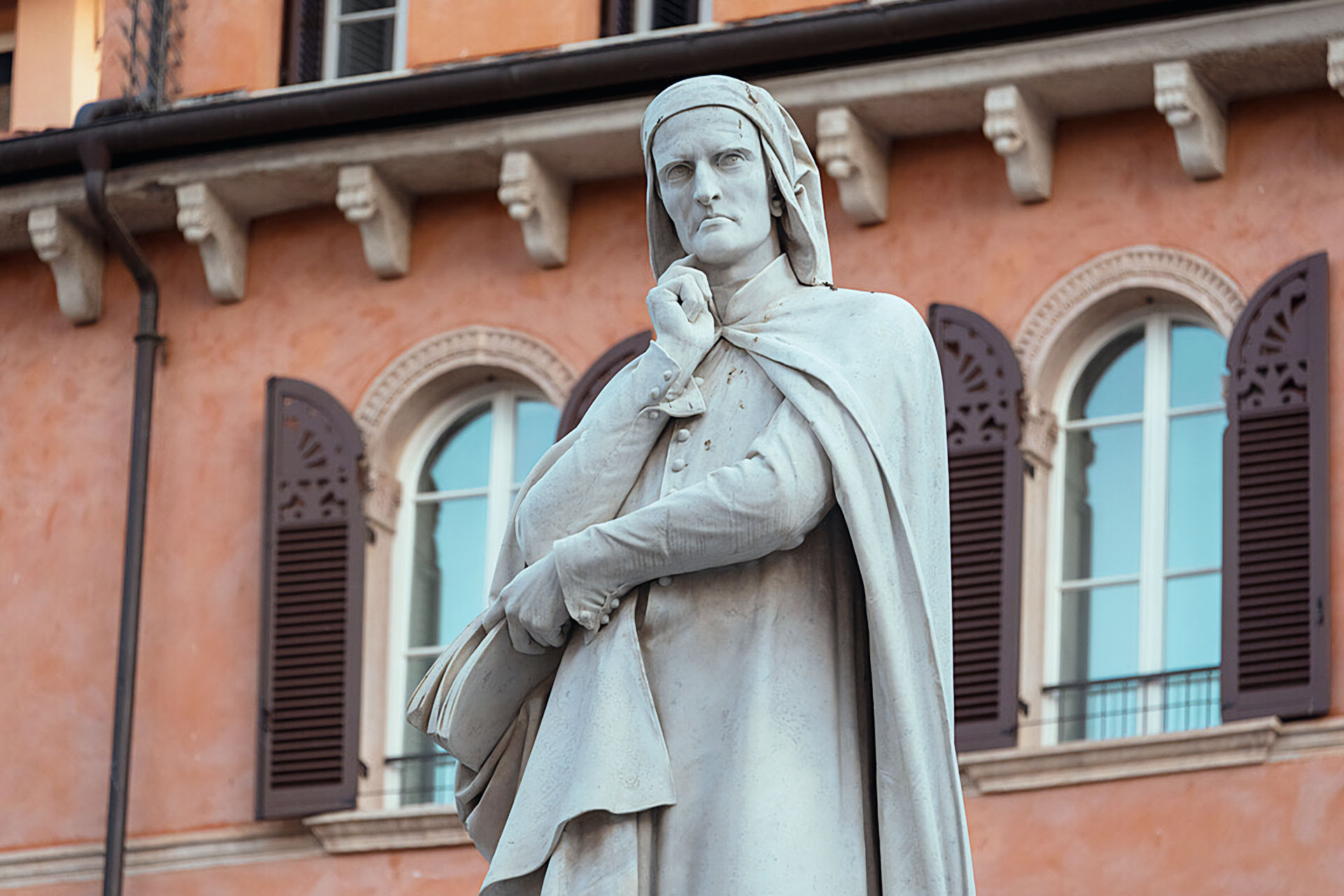
Here, too, Dante has in the Divine Comedy made us a blueprint. His poem is not an epic poem in the classical sense, but it is still grand, majestic, and all-encompassing; it is not a Miltonic pamphlet, but is still thoroughly political and judgmental of worldly businesses, not even hesitating to fling accusations against the clergy; it is not Revelation, but it still concludes, as St. John concluded, with “mind … smitten by a flash … Love that moves the sun and other stars.”15 In Trier, Dante’s portrait adorns the pedestal of His Excellency Baldwin of Luxembourg’s memorial statue; but a reversal of their roles might as much be justified, for Dante’s verse is perhaps sharper than Baldwin’s sword. Dante is therefore called in the Italian “il Sommo Poeta,” the Supreme Poet,16 and as much honor as he held for Virgil, his own eclipses that of his predecessor. The classification of the Divine Comedy as a “Christian epic” is well-deserved, for as much power as the adjective “Christian” holds, all of it may be rightfully attributed to Dante’s poetry, because he, at the beginning of the 14th century, reinvented poetry, and, unlike Milton or especially Goethe, made it wholly Christian. Not a bad feat for a feeble Florentine. Coincidentally, Dante ascended to “the sun and other stars” on this day, September 14th, in the year 1321, long before both Milton and Goethe descended down to us from the same stars.
I shall therefore give to all Christian poets out there, and those who aspire toward truly Christian poetry, the advice given at night by the Lord God to St. Paul: “Be not afraid, but speak, and hold not thy peace.”17 Let us, too, be feeble Florentines. Let us as Christian poets eclipse the epic. Let instead our poetry be prophecy. Amen.
*
* *
Signed Mannheim, October 15th, 2025. Published September 14, 2026, the 705th year since the death of Dante Alighieri.
- Weston, Peter, John Milton, Paradise Lost (London: Penguin Books, 1990), 12–13. ↩︎
- Smith, Nigel, Is Milton Better Than Shakespeare? (Cambridge: Harvard University Press, 2008), 4 ↩︎
- Ibid. 11. ↩︎
- As expressed by Milton himself in his poem Ad Patrem. Cf. MacKellar, Walter, trans. “The Latin Poems of John Milton,” Cornell Studies in English, Vol. 15 (London: Yale University Press, 1930), 142–149. ↩︎
- Milton, Paradise Lost 1:124. ↩︎
- Something akin to the modern government office of the Foreign Minister, though Milton’s office under Cromwell was concentrated on Latin. Cf. Edmonds, Cyrus R. John Milton: A Biography (London: Albert Cockshaw, 1851), 150 ↩︎
- Cf. Hale, John K. Milton’s Languages: The impact of multiculturalism on style (Cambridge: Cambridge University Press, 1997), 8. ↩︎
- Milton, John, “Of true religion, hæresie, schism, toleration, and what best means may be us’d against the growth of popery,” University of Michigan Library Digital Collections (London: 1673), 13, quod.lib.umich.edu/A50917.0001.001 (accessed Oct 11, 2025). ↩︎
- Ibid. 8. ↩︎
- Milton, Paradise Lost 2:648–680. ↩︎
- Cf. Exdous 32. ↩︎
- Milton, Paradise Lost 1:6–22. ↩︎
- Alighieri, Dante. The Divine Comedy, Vol. I, trans. Charles Eliot Norton (Boston: Houghton, Mifflin & Co., 892), xi. ↩︎
- CCC 2696. ↩︎
- Dante, Paradiso 33:140–145. ↩︎
- Alighieri, Dante, Inferno, trans. H. F. Cary (London, Paris, Melbourne: Benton Press, 2013), 1. ↩︎
- KJV, Acts 18:9. ↩︎
